Image
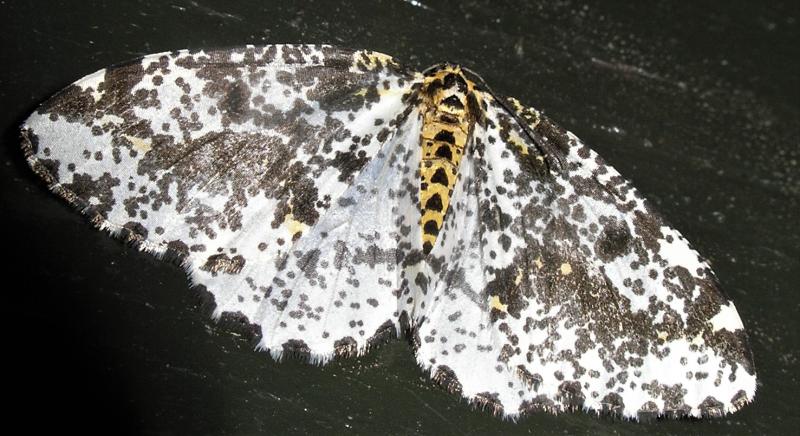
Life stage
Email (of contributor)
scopsowl@gmail.com
Notes (optional)
ID: Abraxas metamorpha Warren, 1893
Abraxas metamorpha sp. n. Proc. zool. Soc. Lond. 1893 (2) Pg 392-393 available at https://archive.org/details/proceedingsofgen93scie/page/392/mode/1up?view=theater
Abraxas (Abraxas) metamorpha; Inoue, 1995, Tinea 14 (suppl. 2): 121, pl. 120, f. 6
SS: Looks more like Abraxas trigonomorpha, Inoue, 1995, Tinea 14 (suppl. 2): 121, pl. 120, f. 4-5. Can one reliably separate these two using images?
GI : I too, at first thought it could be trigonomorpha, but the description given in Proc.zool.Soc.London 1893 matches; In the concluding part of the description," This form, I believe, occurs also in Japan. In Mr. Elwes’s collection is a single female, rather larger than the Sikkim specimens, and with the sinuous submarginal band entirely interrupted for a short distance just above the centre by the pale ground-colour, which interruption gives the specimen a decidedly different appearance, but the central yellow line is present as in the Sikkim insect." The yellow line, which is faint but definitely present.
See the following:
A metamorpha: https://v3.boldsystems.org/index.php/Taxbrowser_Taxonpage?taxid=274660
A trignomorpha: https://v3.boldsystems.org/index.php/Taxbrowser_Taxonpage?taxid=535126
SS: Abraxas are really difficult to separate using images. I would still go with Abraxas spp.
Abraxas metamorpha sp. n. Proc. zool. Soc. Lond. 1893 (2) Pg 392-393 available at https://archive.org/details/proceedingsofgen93scie/page/392/mode/1up?view=theater
Abraxas (Abraxas) metamorpha; Inoue, 1995, Tinea 14 (suppl. 2): 121, pl. 120, f. 6
SS: Looks more like Abraxas trigonomorpha, Inoue, 1995, Tinea 14 (suppl. 2): 121, pl. 120, f. 4-5. Can one reliably separate these two using images?
GI : I too, at first thought it could be trigonomorpha, but the description given in Proc.zool.Soc.London 1893 matches; In the concluding part of the description," This form, I believe, occurs also in Japan. In Mr. Elwes’s collection is a single female, rather larger than the Sikkim specimens, and with the sinuous submarginal band entirely interrupted for a short distance just above the centre by the pale ground-colour, which interruption gives the specimen a decidedly different appearance, but the central yellow line is present as in the Sikkim insect." The yellow line, which is faint but definitely present.
See the following:
A metamorpha: https://v3.boldsystems.org/index.php/Taxbrowser_Taxonpage?taxid=274660
A trignomorpha: https://v3.boldsystems.org/index.php/Taxbrowser_Taxonpage?taxid=535126
SS: Abraxas are really difficult to separate using images. I would still go with Abraxas spp.
Name for copyright (do not include copyright symbol)
Geetha Iyer
HighLighted Contributions
No
Species Node
Overwrite img
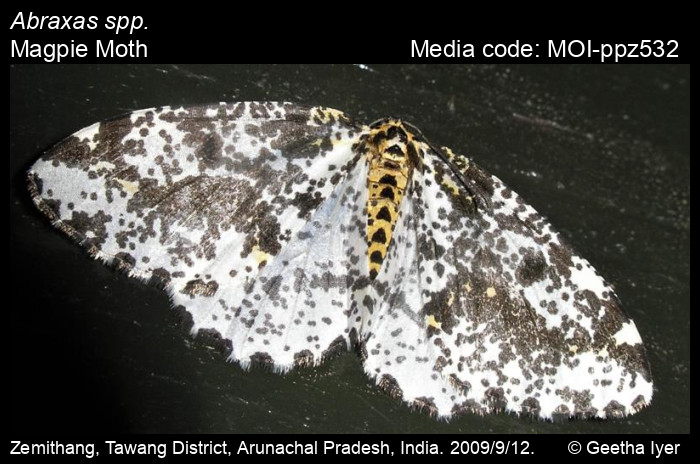
Organism
Butterfly
Moth Taxon search:
Month
September
Year
2009
Day
12
Choose copyright license
Copyrighted (all rights reserved)