Image
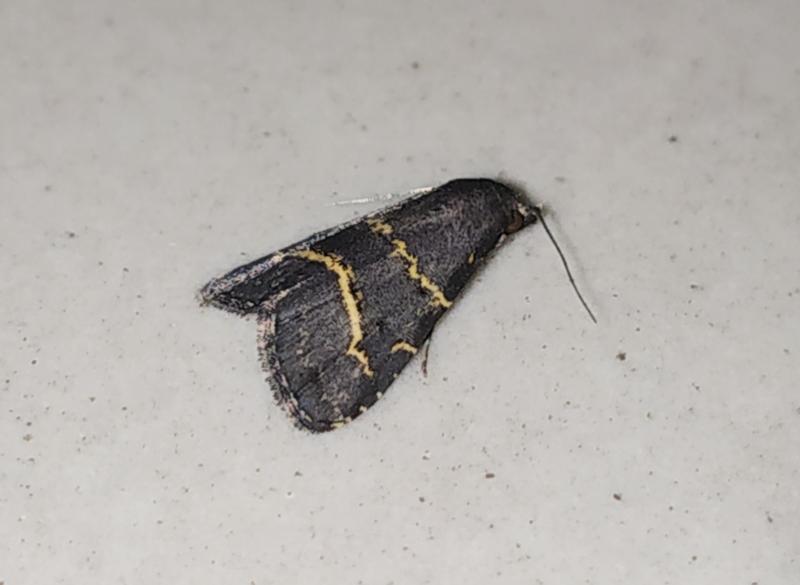
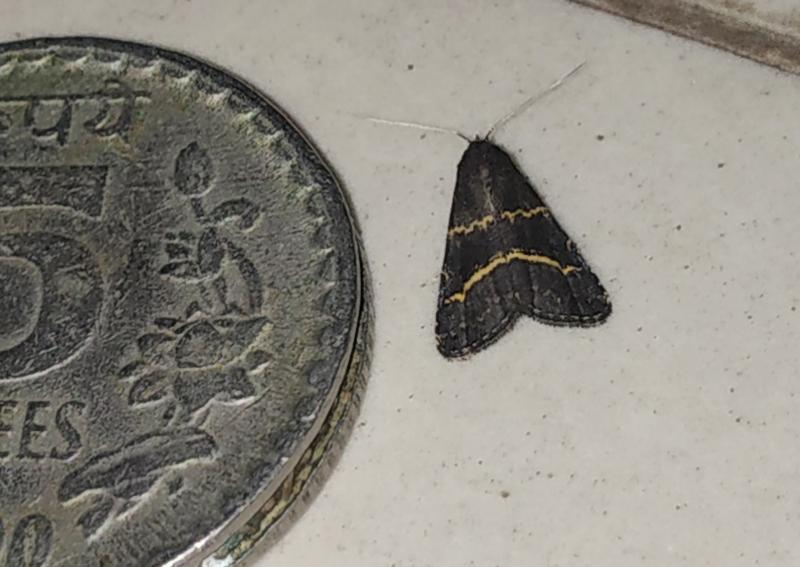
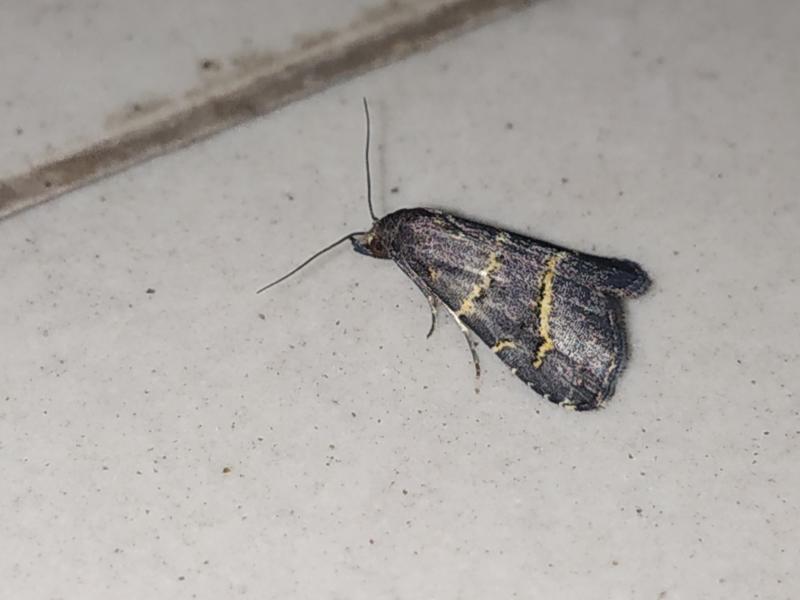
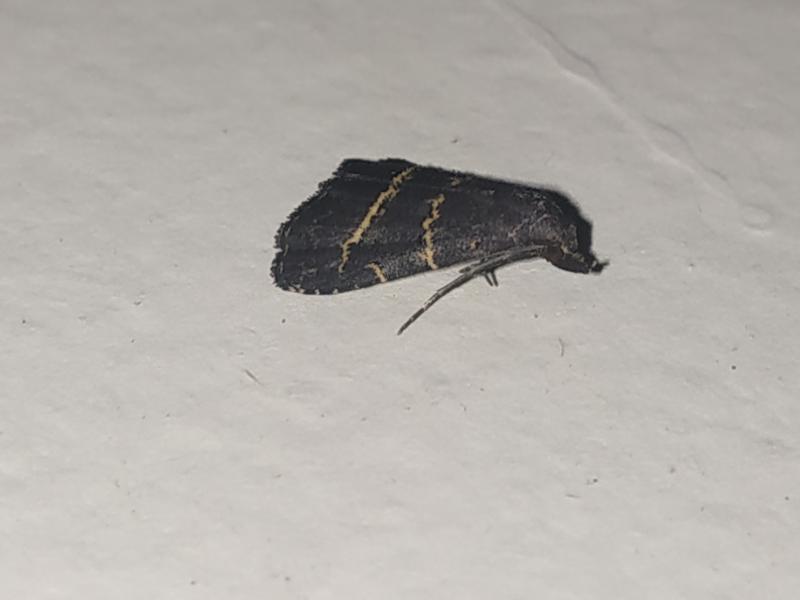
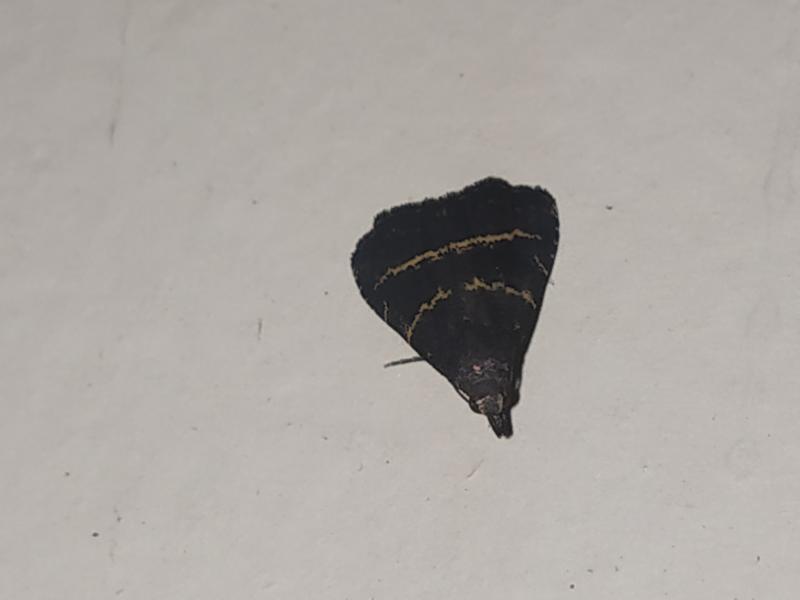
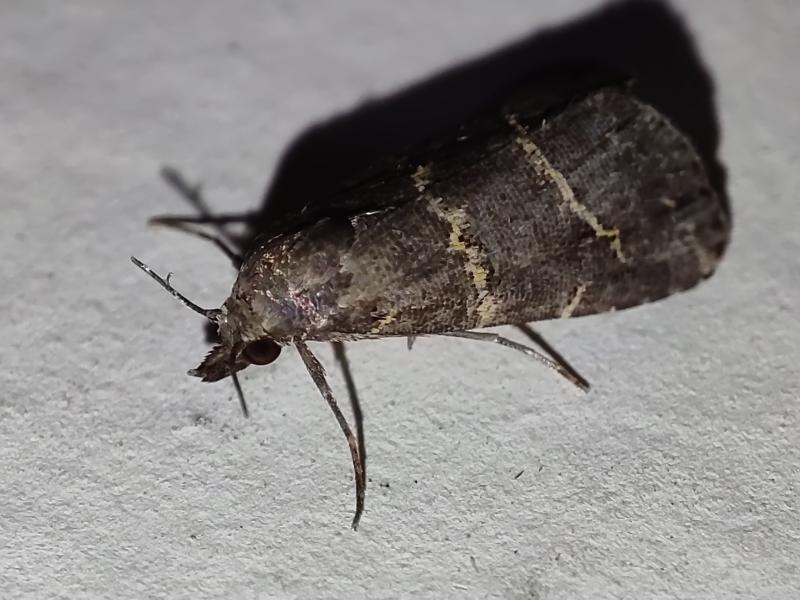
Life stage
Email (of contributor)
po.po.pro.moths@gmail.com
Notes (optional)
Proposed ID: Luceria aurantilineata (Hampson, 1896)
References
1. https://www.biodiversitylibrary.org/page/46942751#page/578/mode/1up (original description of Chusaris aurantilineata by G. Hampson in the Fauna of British India vol.2; type locality Ceylon)
2. https://www.ncbi.nlm.nih.gov/pmc/articles/PMC3561679/
(A new species of Schrankia Hübner from China...; contains list of species based on geographical divisions)
3. Poole, 1989
Lepidopterorum catalogus (New Series) 118: Noctuidae Lepid. cat. (n.s.) 118: (contains the list where Poole has placed the species in Luceria instead of Schrankia, where most others, incuding Holloway (1977) had placed it before)
4. https://www.nhm.ac.uk/our-science/data/lepindex/detail/?taxonno=291547&&snoc=aurantilineata&search_type=starts&sort=snoc&indexed_from=1&page_no=1&page_size=30&path=search (Lepindex NHM card, missing details except species name)
Notes
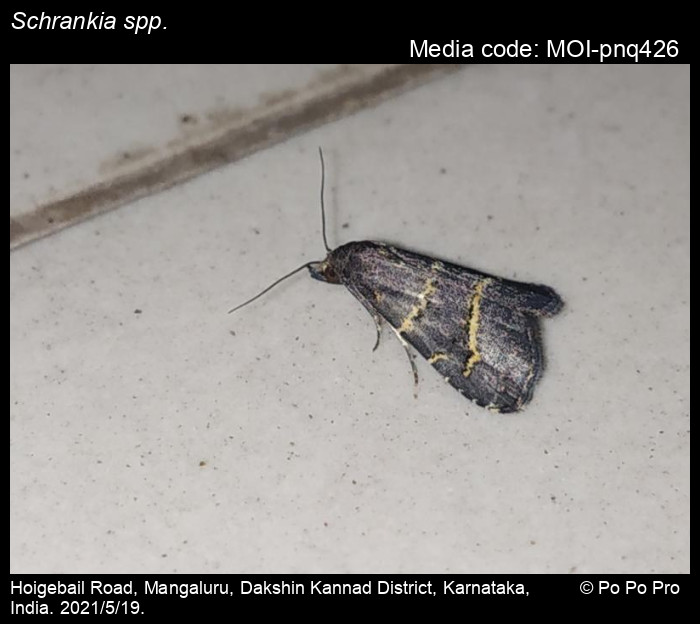
The checklist in ref. 2 mentions only two species in the Ceylon region (or India), of which S. croceipicta is not a good match. I feel S. aurantilineata matches well. In the absence of an illustration, the original description remains the only reference we can consider for this species.
Interestingly, I find Schrankia bilineata Galworthy, 1997 to be an almost exact match in external appearance to this moth. Many observations of this species are on the web, all from Hong Kong.
https://www.inaturalist.org/observations?verifiable=true&taxon_id=486913&locale=en
S. bilineata is mentioned as being restricted to locales of Hong Kong. Dr. Roger Kendrick was kind enough to send me a epdf containing the original description (the holotype of this species was collected by Dr. Kendrick), which I paste below as text. I asked Dr. Kendrick if it is possible that the species had a wider range and if this one could be the same. He said that it couldn't be ruled out, as these are small moths, but will of course need dissection and sequencing of specimens from both locations to confirm any similarity or differences.
There is at least one similar-looking observation from W. Bengal, so I feel it's not impossible that this species has a wider range.
________________________________
Description of S. bilineata Galworthy, 1997
Schrankia bilineata sp nov
Male (Plate 1,19): forewing 6.5 mm; forewing ground colour purple-brown, with a slightly curved creamy white antemedian line, bordered distally with black from the discal area to the hind margin; a further creamy white postmedian line, bordered basally for most of its length with black, running parallel to the outer margin from the hind margin to the costal edge of the discal area, then turning sharply towards the base for a short distance before curving to meet the costa; costa with a series of white spots from the postmedian to the apex; a marginal row of dark spots between the veins; fringes darker than the wing; hindwing light brown, almost unmarked.
Female: unknown.
________________________________
One possible point of contention in the original description of Chusaris aurantilineata is that the indistinct submarginal line is described as orange. It appears whitish in the observation. But many of the S. bilineata observations (assuming they are similar) show the line appearing orangish in close-up shots; yet the original description of bilineata itself doesn't describe any of the lines as orange, incl. the antemedial and the postmedial. They are described as 'creamy-white'. I think it's left to the perception of the observer, the light, and the freshness of the specimen in question.
At least the specific epithet aurantilineata (for the Ceylon moths) seems to be a direct reference to the golden colour of the major lines.
SS: Not completely convinced of genus/species level ID. The discrepancy of the orange/creamy-white coloration is obvious, as is the ground colour, which is almost black, compared to Schrankia bilineata. The other issue that I have is that all Luceria/Schrankia have extended palpi, which I do not see in any of these images. Could it be a different genus?
Po-po-pro: Thanks for reviewing this observation.
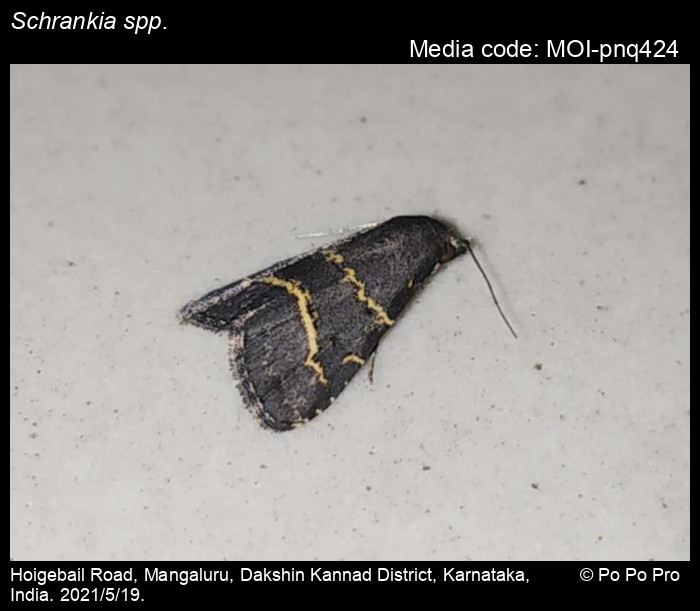
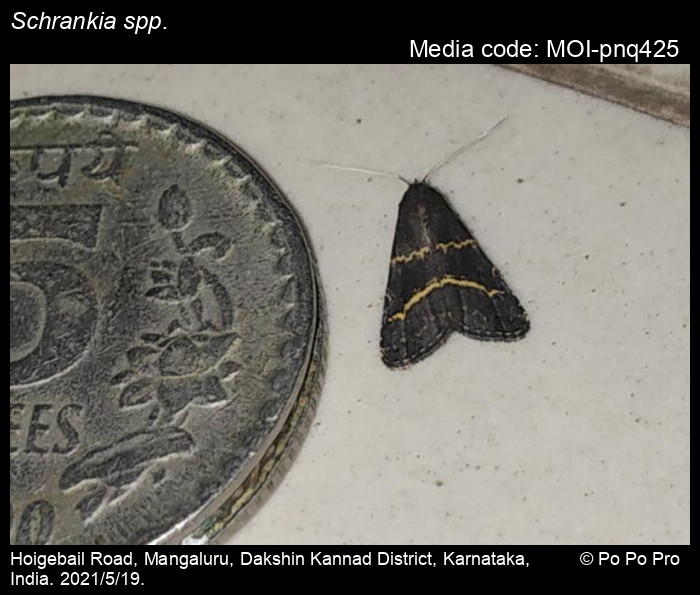
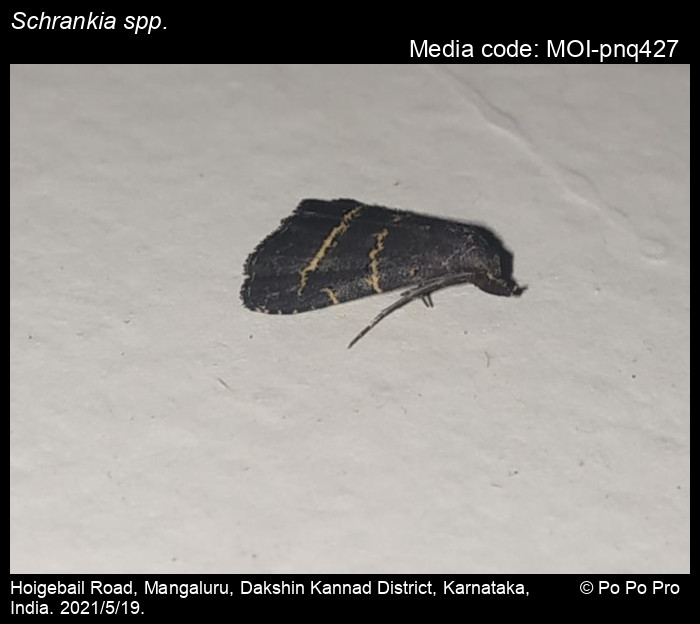
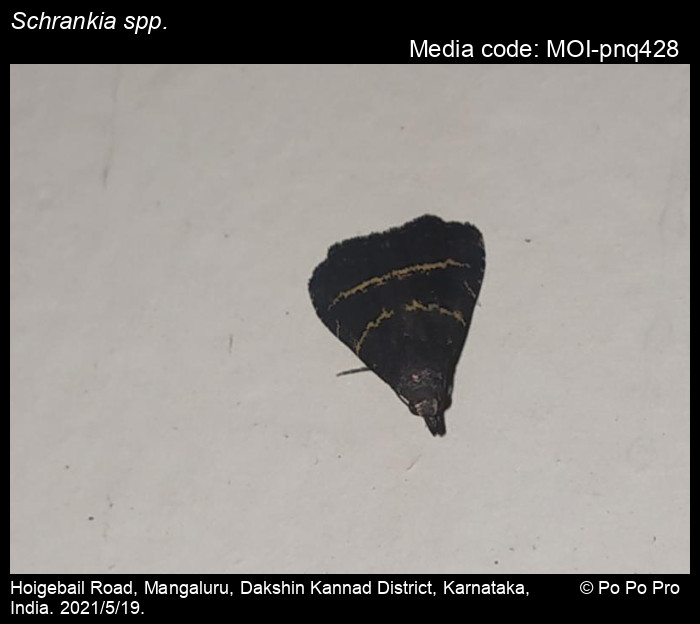
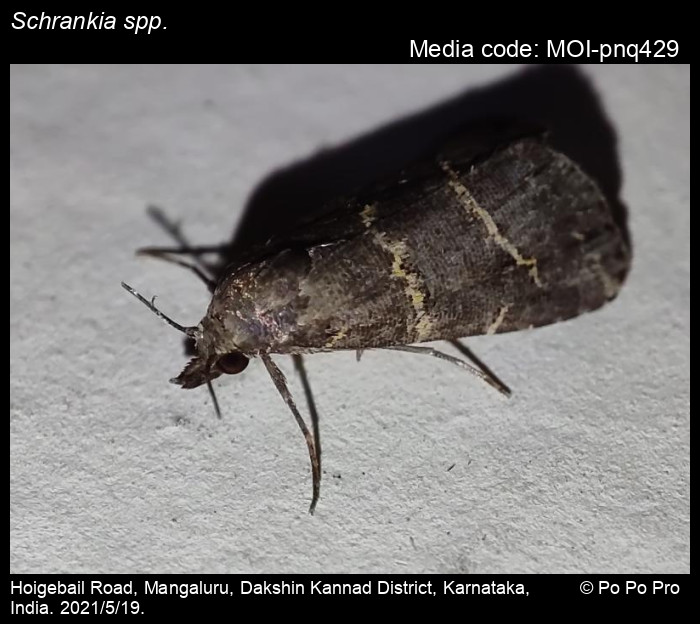
I had deliberately chosen an image in which the fasciation was better visible, so that it might be easier to compare with the description. Now I have added additional images for reference, which show the palps better. They are the same type as in S. bilineata.
For now, as the literature stands, I'm treating bilineata as a Hong Kong species. So, if we go by the Hampson's Ceylon description of Chusaris aurantilineata, the ground colour is indeed described as 'black', and the lines orange.
I have three observations of this species – this one from 2021 and two in June/July 2022. I uploaded the one which looked fresher than the other two. In the worn specimens, the black scales are somewhat faded/lost from the wings and the colour appears greyish or less black, like in several of the Hong Kong observations of bilineata. I would say the lines tend more towards yellow, than orange. But I remember, without the phone camera and the photographs, my first impression when I spotted this moth with my eyes had been that it was a dark brown moth with orange lines.
I have also uploaded a single photo of a worn specimen from one of the recent observations for reference (please disregard it because the observation date is different). It was taken with a better camera and shows the palps more clearly.
SS: Based on these images, where the palpi are visible, I am ok to go with Luceria aurantilineata (Hampson, 1896). Lets wait for others to review.
Jonathan feedback: I had checked Po po pro's observation and references, the OD seemed to be rather vague and the illustrations not matching fully. Could not get alternate references.
Po-po-pro: Unfortunately, Hampson's description is the only direct reference available for this species. This moth is an exact match for the Hong Kong specimens ID'd as Schrankia bilineata, which helps to confirm that the genus is correct. The closest matching species described from the southern Indian region is Hampson's aurantilineata, previously placed in Schrankia and now Luceria. There's no other moth species ID'd anywhere on the web as aurantilineata, which leaves a vacancy for this one. I suggested the ID based on the above.
May I know which illustrations Jonathan refers to? There doesn't seem to be an illustration associated with Hampson's description.
Po-po-pro (1/1/2023): I tried to search deeper for any clues, and ended up finding a Schrankia observation from the type locality Ceylon (by Nuwan) which is similar but seems to have the antemedial and postmedial lines farther apart from each other. Though this one is also not a perfect match, it becomes a candidate for Hampson's aurantilineata. Hence, I feel it would be prudent to keep our observation to genus level as Schrankia spp. till the holotype becomes available in the public domain, or further studies emerge.
Below is linked the Sri Lankan observation:
https://www.inaturalist.org/observations/66574649
SS: Yes, I think its best we publish this at the genus level. Schrankia spp./Luceria spp.
References
1. https://www.biodiversitylibrary.org/page/46942751#page/578/mode/1up (original description of Chusaris aurantilineata by G. Hampson in the Fauna of British India vol.2; type locality Ceylon)
2. https://www.ncbi.nlm.nih.gov/pmc/articles/PMC3561679/
(A new species of Schrankia Hübner from China...; contains list of species based on geographical divisions)
3. Poole, 1989
Lepidopterorum catalogus (New Series) 118: Noctuidae Lepid. cat. (n.s.) 118: (contains the list where Poole has placed the species in Luceria instead of Schrankia, where most others, incuding Holloway (1977) had placed it before)
4. https://www.nhm.ac.uk/our-science/data/lepindex/detail/?taxonno=291547&&snoc=aurantilineata&search_type=starts&sort=snoc&indexed_from=1&page_no=1&page_size=30&path=search (Lepindex NHM card, missing details except species name)
Notes
The checklist in ref. 2 mentions only two species in the Ceylon region (or India), of which S. croceipicta is not a good match. I feel S. aurantilineata matches well. In the absence of an illustration, the original description remains the only reference we can consider for this species.
Interestingly, I find Schrankia bilineata Galworthy, 1997 to be an almost exact match in external appearance to this moth. Many observations of this species are on the web, all from Hong Kong.
https://www.inaturalist.org/observations?verifiable=true&taxon_id=486913&locale=en
S. bilineata is mentioned as being restricted to locales of Hong Kong. Dr. Roger Kendrick was kind enough to send me a epdf containing the original description (the holotype of this species was collected by Dr. Kendrick), which I paste below as text. I asked Dr. Kendrick if it is possible that the species had a wider range and if this one could be the same. He said that it couldn't be ruled out, as these are small moths, but will of course need dissection and sequencing of specimens from both locations to confirm any similarity or differences.
There is at least one similar-looking observation from W. Bengal, so I feel it's not impossible that this species has a wider range.
________________________________
Description of S. bilineata Galworthy, 1997
Schrankia bilineata sp nov
Male (Plate 1,19): forewing 6.5 mm; forewing ground colour purple-brown, with a slightly curved creamy white antemedian line, bordered distally with black from the discal area to the hind margin; a further creamy white postmedian line, bordered basally for most of its length with black, running parallel to the outer margin from the hind margin to the costal edge of the discal area, then turning sharply towards the base for a short distance before curving to meet the costa; costa with a series of white spots from the postmedian to the apex; a marginal row of dark spots between the veins; fringes darker than the wing; hindwing light brown, almost unmarked.
Female: unknown.
________________________________
One possible point of contention in the original description of Chusaris aurantilineata is that the indistinct submarginal line is described as orange. It appears whitish in the observation. But many of the S. bilineata observations (assuming they are similar) show the line appearing orangish in close-up shots; yet the original description of bilineata itself doesn't describe any of the lines as orange, incl. the antemedial and the postmedial. They are described as 'creamy-white'. I think it's left to the perception of the observer, the light, and the freshness of the specimen in question.
At least the specific epithet aurantilineata (for the Ceylon moths) seems to be a direct reference to the golden colour of the major lines.
SS: Not completely convinced of genus/species level ID. The discrepancy of the orange/creamy-white coloration is obvious, as is the ground colour, which is almost black, compared to Schrankia bilineata. The other issue that I have is that all Luceria/Schrankia have extended palpi, which I do not see in any of these images. Could it be a different genus?
Po-po-pro: Thanks for reviewing this observation.
I had deliberately chosen an image in which the fasciation was better visible, so that it might be easier to compare with the description. Now I have added additional images for reference, which show the palps better. They are the same type as in S. bilineata.
For now, as the literature stands, I'm treating bilineata as a Hong Kong species. So, if we go by the Hampson's Ceylon description of Chusaris aurantilineata, the ground colour is indeed described as 'black', and the lines orange.
I have three observations of this species – this one from 2021 and two in June/July 2022. I uploaded the one which looked fresher than the other two. In the worn specimens, the black scales are somewhat faded/lost from the wings and the colour appears greyish or less black, like in several of the Hong Kong observations of bilineata. I would say the lines tend more towards yellow, than orange. But I remember, without the phone camera and the photographs, my first impression when I spotted this moth with my eyes had been that it was a dark brown moth with orange lines.
I have also uploaded a single photo of a worn specimen from one of the recent observations for reference (please disregard it because the observation date is different). It was taken with a better camera and shows the palps more clearly.
SS: Based on these images, where the palpi are visible, I am ok to go with Luceria aurantilineata (Hampson, 1896). Lets wait for others to review.
Jonathan feedback: I had checked Po po pro's observation and references, the OD seemed to be rather vague and the illustrations not matching fully. Could not get alternate references.
Po-po-pro: Unfortunately, Hampson's description is the only direct reference available for this species. This moth is an exact match for the Hong Kong specimens ID'd as Schrankia bilineata, which helps to confirm that the genus is correct. The closest matching species described from the southern Indian region is Hampson's aurantilineata, previously placed in Schrankia and now Luceria. There's no other moth species ID'd anywhere on the web as aurantilineata, which leaves a vacancy for this one. I suggested the ID based on the above.
May I know which illustrations Jonathan refers to? There doesn't seem to be an illustration associated with Hampson's description.
Po-po-pro (1/1/2023): I tried to search deeper for any clues, and ended up finding a Schrankia observation from the type locality Ceylon (by Nuwan) which is similar but seems to have the antemedial and postmedial lines farther apart from each other. Though this one is also not a perfect match, it becomes a candidate for Hampson's aurantilineata. Hence, I feel it would be prudent to keep our observation to genus level as Schrankia spp. till the holotype becomes available in the public domain, or further studies emerge.
Below is linked the Sri Lankan observation:
https://www.inaturalist.org/observations/66574649
SS: Yes, I think its best we publish this at the genus level. Schrankia spp./Luceria spp.
Name for copyright (do not include copyright symbol)
Po Po Pro
Location (type location name here, or create a new location below under "Choose on the map")
HighLighted Contributions
No
Species Node
Overwrite img
Organism
Butterfly
Moth Taxon search:
Month
May
Year
2021
Day
19
Choose copyright license
Creative Commons (CC-BY-NC 4.0 International license)